LinkedIn SSI score: what it is, and whether you can still see yours
By Miles Burke · Updated · 8 minute read
The short answer
Your LinkedIn SSI score, short for Social Selling Index, is a number out of 100 that LinkedIn calculates from four things: establishing your professional brand, finding the right people, engaging with insights and building relationships. It is updated daily. For years any member could see theirs for free at linkedin.com/sales/ssi. Since around September 2026 that page has been telling members their access has been discontinued, and LinkedIn itself now says the score no longer reflects how selling works. Nothing has replaced it. The four habits it measures are still worth having.
For years LinkedIn kept a score on every member that most of them had never seen. It is called the Social Selling Index, it runs from 0 to 100, and salespeople have watched theirs closely. Everyone else tended to discover it by accident, wonder briefly whether 54 was good, and never go back.
There is a new wrinkle. When we went to check ours in October 2026, LinkedIn would not show it. This guide explains what the LinkedIn SSI score measures, whether you can still see yours, how to raise it if you can, and what to do if you cannot.
What the LinkedIn SSI score is
LinkedIn introduced the Social Selling Index for sales teams, as a way to measure how well a salesperson was using LinkedIn to find and get to know buyers. "Social selling" is the practice behind the name: building a reputation and relationships online, so that when you do get in touch with someone, you are not a stranger.
The score was never limited to people in sales. LinkedIn calculated one for ordinary members too, and the four things it measures apply just as well to a consultant in Toronto looking for clients, a founder in Berlin looking for investors, or someone in Singapore looking for their next role.
What it is not is a measure of results. Your SSI goes up when you do certain things. It does not know whether any of them led anywhere.
How to find your SSI score, and why you may not be able to
- Sign in to LinkedIn on a computer or a phone.
- Go to linkedin.com/sales/ssi.
- If you have access, your score appears, with its four parts underneath.
That third step now carries an "if". The page belongs to Sales Navigator, LinkedIn's paid product for sales teams, and for a long time LinkedIn let any member look at it for nothing. On 13 October 2026 we opened it with an ordinary account that does not have Sales Navigator, and got this instead:
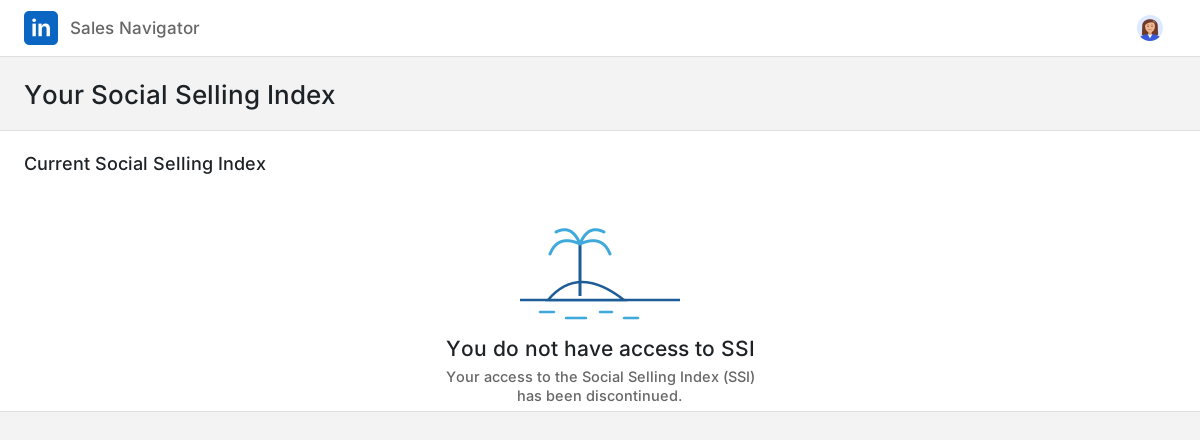
The message reads: "Your access to the Social Selling Index (SSI) has been discontinued." We are far from alone. Other people writing about LinkedIn report the same screen appearing widely from September 2026, on different accounts at different times. Try the address above and you will know in ten seconds whether yours is one of them.
Two things people try do not seem to bring it back. Upgrading to LinkedIn Premium is reported to make no difference. Sales Navigator might: some long-standing subscribers say the page still works for them, but LinkedIn does not list the score among Sales Navigator's features, so it is no guarantee. We have not been able to test either ourselves.
LinkedIn is moving away from SSI
This does not look like a glitch. LinkedIn's Sales Navigator site has a page titled "From SSI to AI", subtitled "What's next for the Social Selling Index". It says the SSI score "no longer accurately reflects the modern sales environment", that a high score does not always go with real sales results, and that the effort of chasing one can distract from closing deals. It then steers sales teams towards the AI tools in Sales Navigator and suggests they measure those instead.
What LinkedIn has not published is a dated notice. There is no announcement saying when access ends or for whom, and the page above still carries a "Get your SSI score" link that leads to the message saying you cannot have one. The reasoning has been public for some time, though: the change was being reported in the business press in late 2025, close to a year before most people ran into the locked page.
Notice, too, what LinkedIn is offering in its place. It is not a better score. It is a set of paid tools for sales teams. If you are a consultant, a founder or anyone else who used SSI as a rough check on how you were doing, nothing has replaced it.
There is nowhere else on LinkedIn to see the score. It was never part of the ordinary menus or of your analytics pages.
What the page shows when you can see it
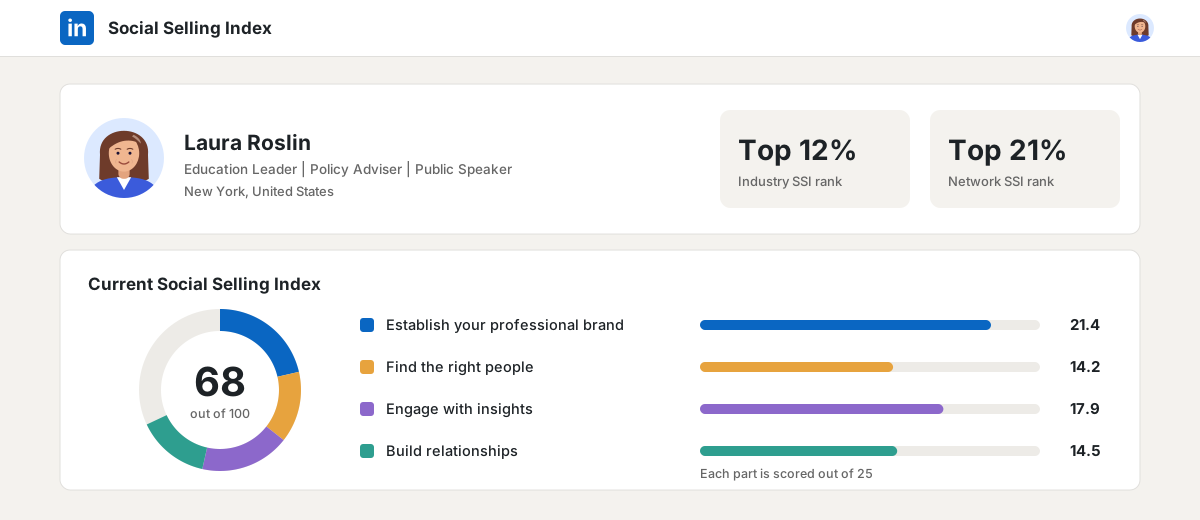
Alongside the score, the page has given two rankings: where you stand among people in your industry and among people in your network, each shown as a "top" percentage. It has also shown the average score for both groups, and whether your own has gone up or down since last week.
The four parts of the score
Whether or not you can see the number, the four things behind it are worth knowing. LinkedIn's own description, still on the page, is that SSI measures how effective you are at establishing your professional brand, finding the right people, engaging with insights and building relationships.
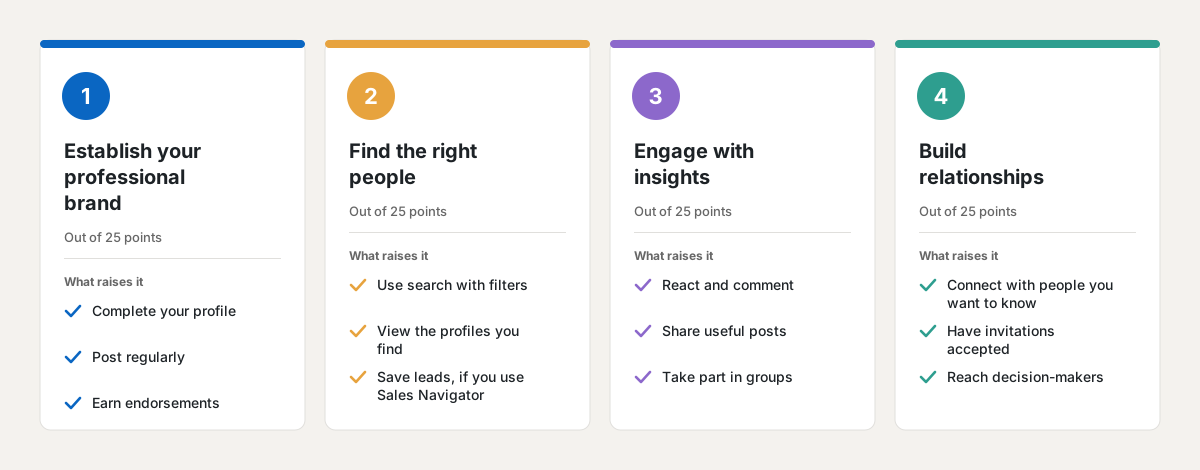
The total is the sum of those four parts, each scored out of 25. Knowing which is which matters, because the quickest way to raise a score is to work on whichever part is lowest.
1. Establish your professional brand
How complete your profile is, and how much you publish. A profile with a photo, a headline that says what you do, a filled-in About section and a work history scores better than a bare one. Posting, and having people respond to your posts, adds to it.
2. Find the right people
How much you use LinkedIn to look for people: searching, using filters, and viewing the profiles you find. This is the part most people score lowest on, because it rewards behaviour that comes naturally to someone prospecting for customers and to almost nobody else. Sales Navigator users have more ways to raise it.
3. Engage with insights
How much you take part: reacting to and commenting on other people's posts, sharing things, and joining in discussions. It rewards being a regular participant and not only a publisher.
4. Build relationships
How you grow your network: connecting with people, especially senior ones, and having your invitations accepted. An invitation that is ignored does not help, which is one reason to add a note saying why you are asking.
What is a good SSI score?
LinkedIn does not say. There is no official pass mark, and the numbers you will see quoted online, that 70 is good or that 75 puts you in the top tier, are habit, not policy.
The page gives you something more useful than a universal figure: the average for people in your own industry and in your own network. Those are your real comparisons. A score of 55 is strong in a field where the average is 30, and ordinary in one where it is 60.
It is also worth looking at the shape of your score as well as its size. Someone on 60 made up of four fifteens is using LinkedIn in a balanced way. Someone on 60 made up of 24, 6, 22 and 8 has two strengths and two things they never do. The second person can gain points far more easily than the first.
How to improve your SSI score
If you can see your score, start with your lowest part. Because each is capped at 25, the last few points of a strong part are slow to earn, while a weak part can rise quickly. If you cannot see it, read the table as a checklist and ask yourself honestly which of the four you do least.
| If this part is low | Do this |
|---|---|
| Establish your professional brand | Fill every section of your profile, rewrite your headline to say who you help, and post once or twice a week. |
| Find the right people | Spend five minutes a few times a week searching for the kind of person you want to reach, using the filters, and open the profiles that look relevant. |
| Engage with insights | Leave three thoughtful comments a day on posts in your field. A comment counts for more than a reaction, and is seen by more people. |
| Build relationships | Send a handful of connection requests a week to people you have a reason to know, each with a short note. Accept the relevant ones you receive. |
Two things to know before you start. The score reflects recent activity, so it rewards a steady habit and falls back if you stop; a busy weekend will not hold it up for a month. And it updates daily, so you will see the effect of a change within a few days.
For the first part in particular, these guides go further: what to post on LinkedIn, how often to post and how to get more followers. For the fourth, see followers vs connections.
Does your SSI score matter?
Less than its prominence among salespeople suggests, and more than nothing. And if LinkedIn has taken yours away, you have lost less than you might think.
The case for it is that the four parts are a fair description of using LinkedIn well. A complete profile, regular posting, taking part in other people's conversations and steadily meeting relevant people are what most advice comes down to. If your score is low, one of those is probably missing, and the page tells you which.
The case against is one LinkedIn now makes itself: a high score does not reliably mean good results. It counts activity and nothing else. You can raise your SSI by searching for people you have no interest in and connecting with strangers who will never read a word you write. Your score will go up and your results will not. A high SSI is evidence that you are busy on LinkedIn, not that it is working.
People also ask whether a higher score makes LinkedIn show their posts to more people. LinkedIn has not said so. Posting and commenting regularly do tend to increase reach, and they also raise the score, so the two rise together. That is not the same as one causing the other.
SSI and your analytics measure different things
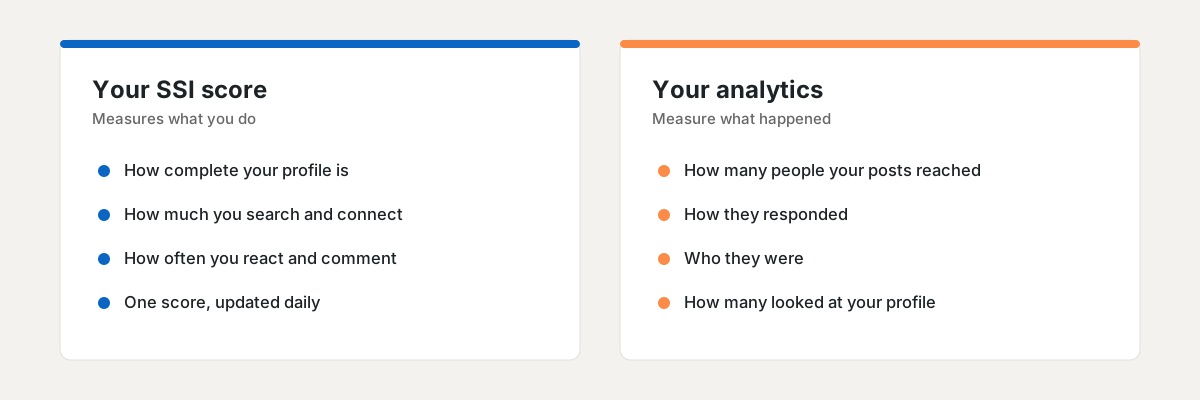
This is the distinction worth holding on to. SSI looks at your behaviour: did you post, search, comment, connect? Your personal LinkedIn analytics look at the outcome: how many people saw your posts, how they responded, who they were, and how many came to look at your profile.
This is also the answer for anyone who can no longer see their score. Your analytics are still free, still yours, and they measure the thing SSI only hinted at: whether your activity is getting anywhere.
If you can see both, they are informative together. If your SSI is rising and your impressions, engagement rate and profile views are rising with it, your extra effort is paying off. If your SSI is rising and nothing else moves, you are being active in ways your audience does not notice, and it is time to change what you do, not do more of it.
What to track now that the score is gone
Do not go looking for another single number. LinkedIn has made clear it is not going to supply one, and a score was only ever a stand-in for the things you care about. Each of the four parts has a real signal behind it that you can still see for free.
| SSI part | What to watch instead | Where it is |
|---|---|---|
| Establish your professional brand | Whether your posts beat your own typical post, and how often you appear in search | Content analytics, and search appearances on the Overview page |
| Find the right people | Whether the people seeing your posts are the people you want | Top demographics in Content analytics |
| Engage with insights | How many comments you leave each week, and whether your own posts start conversations | Your own count, and the Engagement panel |
| Build relationships | New followers, profile viewers, and replies to your messages | Audience analytics, the Overview page, and your inbox |
Note the profile viewers and search appearances figures once a week, because LinkedIn keeps no history of either. See how to keep your LinkedIn analytics history.
Mistakes to avoid
- Chasing the number. Mass connection requests and aimless searching raise the score and lower the quality of your network.
- Comparing across industries. Averages differ a great deal between fields. Use the industry figure on your own page.
- Checking it daily. It moves a little every day. Once a month is plenty.
- Paying to get it back. Premium is reported not to restore the score, and Sales Navigator, a tool for people who prospect for a living, may not either. A number is not a reason to buy one.
- Ignoring the four parts. The total hides where you are weak. The breakdown is the useful bit.
- Treating it as proof. If you sell, the measure that matters is conversations and clients. See how to use LinkedIn for business.
Common questions
What is an SSI score on LinkedIn?
SSI stands for Social Selling Index. It is a score out of 100 that LinkedIn calculates for your account from four kinds of activity: building your profile and posting, finding people, engaging with posts, and making connections.
How do I find my LinkedIn SSI score?
Sign in to LinkedIn and go to linkedin.com/sales/ssi. If you still have access, the page shows your score, its four parts and how you rank. Since around September 2026 many members instead see a message saying their access to SSI has been discontinued.
Why can I not see my LinkedIn SSI score?
LinkedIn has been withdrawing access to the Social Selling Index. When we checked on 13 October 2026, the page said access had been discontinued, and many other members report the same from around September 2026. LinkedIn has published no dated notice, but its own page "From SSI to AI" says the score no longer reflects how selling works and points sales teams to its AI tools instead.
Is LinkedIn getting rid of the SSI score?
It looks that way, though LinkedIn has not said so outright. Its own "From SSI to AI" page says the score no longer accurately reflects modern selling and encourages sales teams to move beyond it, and some members can no longer see their score at all.
Is the LinkedIn SSI score still free?
It was free for many years. From around September 2026, members report being told their access has been discontinued. Upgrading to LinkedIn Premium is reported not to bring it back, and LinkedIn does not list the score as a feature of Sales Navigator, although some long-standing subscribers say they can still see theirs.
What replaced the LinkedIn SSI score?
Nothing that measures the same thing. LinkedIn points sales teams to AI tools in Sales Navigator, which are features, not a score. To judge how you are doing, use your own analytics: how your posts perform against your typical post, who sees them, and your profile viewers and search appearances over time.
What is a good LinkedIn SSI score?
LinkedIn does not publish a pass mark. The page shows the average for your industry and for your network, and beating those is a sensible first aim. Many people treat 70 or more as strong, but that is custom, not an official line.
How do I increase my LinkedIn SSI score?
Find the lowest of your four parts and work on that one. Complete your profile and post regularly for the first, use search for the second, react and comment for the third, and connect with relevant people for the fourth. Small, steady activity raises it more than a burst.
How often is the SSI score updated?
Daily. Because it reflects recent activity, it also falls if you stop being active.
Does a higher SSI score increase my reach on LinkedIn?
LinkedIn has not said that it does. The habits that raise the score, such as posting and commenting regularly, tend to increase reach in their own right, which is probably why the two move together.
See this in your own numbers
Postaboo turns the analytics file LinkedIn lets you download into a clear report, and keeps your history as it grows. Free, with no LinkedIn login.
More guides
- Personal LinkedIn analytics: a complete guide
- How to export your LinkedIn analytics
- LinkedIn only keeps 365 days of analytics. Here is how to keep yours.
- The best time to post on LinkedIn: how to find your own
- What is a good LinkedIn engagement rate?
- What are impressions on LinkedIn?
- Does LinkedIn show who viewed your profile?
- How to use LinkedIn for business, and get clients from it
- Do hashtags work on LinkedIn?
- How to get more followers on LinkedIn
- What to post on LinkedIn, and how long a post should be
- LinkedIn followers vs connections: what is the difference?
- Why did my LinkedIn impressions drop?
- LinkedIn analytics glossary: every term explained